
Service Body Installation in Utah
Heritage Industries installs service truck bodies at our shop in Salt Lake City, on new chassis and on trucks you already own. We are a Milron aluminum and Stellar steel dealer, and we have been building service trucks for Utah’s mining, construction, utility and municipal operations long enough to have opinions about which one you should buy.
This page is those opinions. Most service body pages are a catalogue. This one is about how to choose, because the expensive mistakes in this category are made at the specification stage, not on the shop floor — a body that is too heavy for the chassis, or too short for the work, costs money every day it is in service and cannot be undone afterwards.
Aluminum or Steel?
This is the first decision and it drives everything after it. The honest answer is that it depends on two things: how much payload you need, and whether a crane is going on the truck.
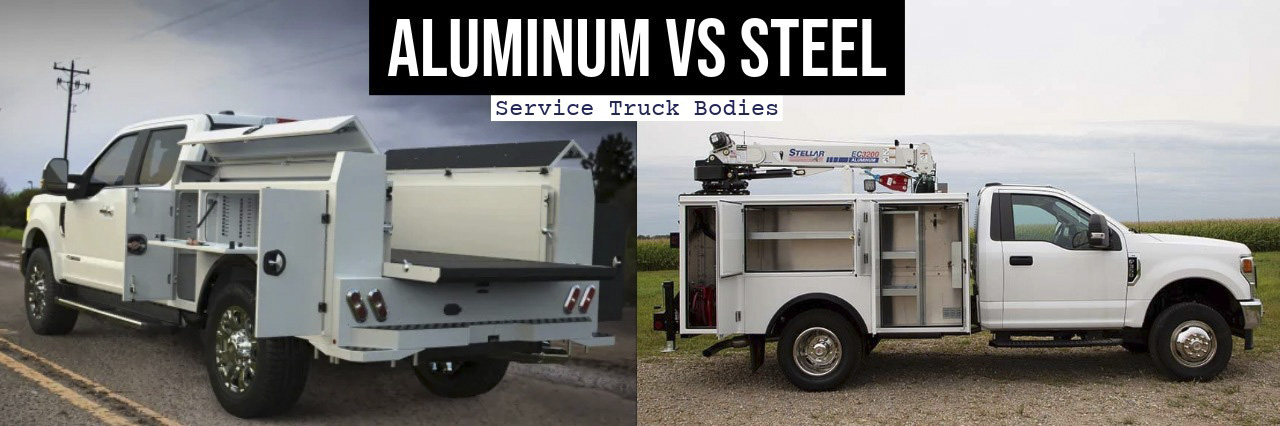
Choose aluminum when payload matters
Milron bodies are built from 100% 5052 high-strength aluminum and run up to 50% lighter than a comparable steel body. Every pound the body does not weigh is a pound you can carry, which for crews hauling tooling, parts and fluids is usually the deciding argument. Aluminum also does not rust, which matters more in Utah than people expect — road salt through a Wasatch winter is hard on a steel body, and a corroding compartment floor is a slow, irreversible write-off.
The trade-off is that aluminum is less tolerant of concentrated structural loads. For most service work this never comes up. For crane work it is the whole question.
Choose steel when loads are concentrated
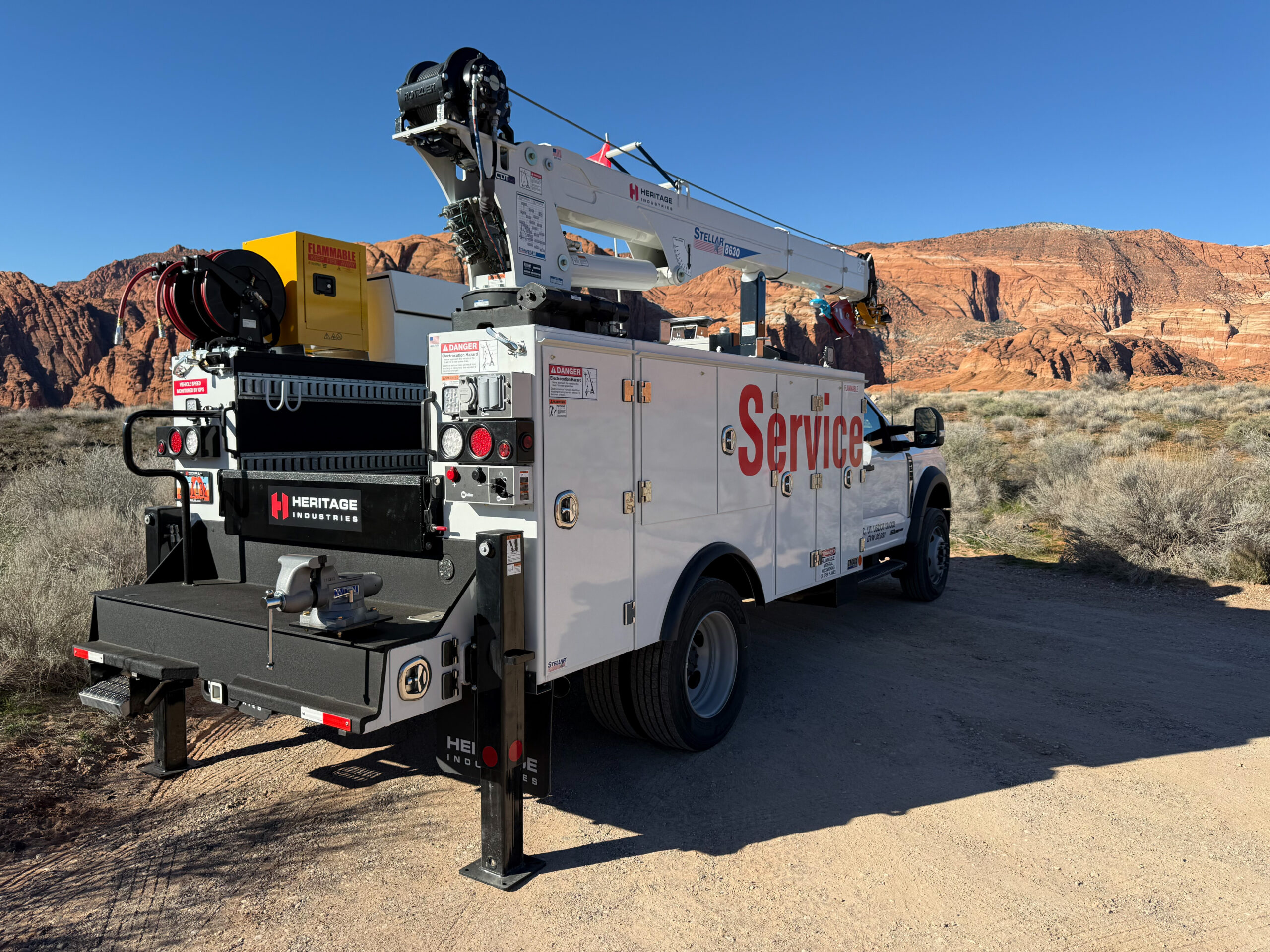
Stellar steel bodies are built for trucks carrying welders, air compressors and hydraulic cranes — loads that put stress into specific points of the structure rather than spreading it across the floor. Stellar’s TMAX bodies use a torsion box understructure that absorbs crane lifting forces, isolates them from the side packs and transfers the stress directly into the chassis, which is what stops compartments cracking over a few thousand lifts.
Steel is heavier and it will eventually rust where the coating is breached. In exchange you get a structure that takes abuse aluminum would not.
The short version
- Carrying tools, parts and fluids, no crane, payload is tight: aluminum.
- Mounting a crane, a welder or a compressor: steel, or a specifically reinforced aluminum body.
- Running in road salt and keeping the truck a decade: aluminum, strongly.
- Not sure yet whether a crane is coming: tell us, because it changes the body you should buy today.
Sizing the Body
Service bodies come in standard lengths that correspond to chassis configurations. Picking the wrong one is the second expensive mistake.
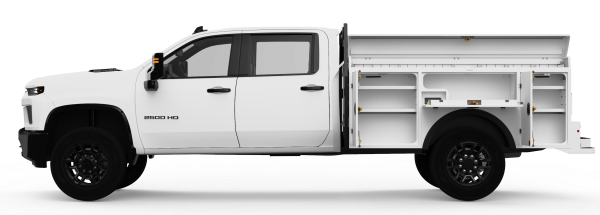
6 foot, single rear wheel
Suits short-bed pickups. The compact option for crews who need organized, lockable storage without moving up a chassis class. Standard on the Milron 6 Series: a short tailgate, six D-ring tie-downs and heavy-duty injection-molded flares.
8 foot, single rear wheel
The direct replacement for a standard 8-foot long box, and the most common choice for general service work. The Milron 8 Series adds open top compartments with dividers on both sides, which is a meaningful amount of extra usable storage for long items that do not fit a side pack.
9 foot, dual rear wheel
The crane-ready option, built on a dual-rear-wheel chassis for mining, construction and oil and gas work. The Milron 9 Series can be reinforced for crane loads up to 8,000 pounds, carries eight D-ring tie-downs rather than six, and comes with Eberhard premium door hardware. If a crane is in the plan, this is where the conversation starts.
Payload: The Calculation Most Buyers Skip
Here is the arithmetic that decides whether a truck works. Your chassis has a Gross Vehicle Weight Rating. Subtract the weight of the truck itself, then the body, then the crane if there is one, then fuel, then the crew, then everything they carry. What is left is your usable payload, and it is almost always less than people assume.
Run that number badly and the consequences are not theoretical: an overloaded truck eats brakes and suspension, voids chassis warranties, handles worse in exactly the conditions where handling matters, and is a liability the day it is weighed.
We work this out before recommending a body. It is a standard part of how we specify a truck, not an extra. Bring us the chassis and an honest list of what the crew actually carries — including the things nobody admits to — and we will tell you what the truck can take.
If a Crane Is Going On It
Crane mounting is not an accessory fitted to a finished body. The body has to be built or reinforced for it, the chassis has to be rated for it, and stability has to be engineered rather than assumed. Stellar bodies are designed with integrated crane mounts for their hydraulic service cranes — the 12630, the 8630 and the 3315 electric-hydraulic — and the Milron 9 Series can be reinforced for crane loads up to 8,000 pounds.
If a crane is a possibility within the life of the truck, say so now. Specifying a crane-capable body today costs a fraction of discovering in two years that the body you bought cannot take one. More on mechanic and crane truck builds.
Finish and Corrosion Protection
Milron bodies are powder-coated using 138 series powder from Tiger Drylac, finished white as standard, with custom colors available. For trucks working in road salt, mine sites or anywhere abrasive, we also apply HI-LINER protective coatings — our spray-applied hybrid polyurea lining, which is watertight, non-slip, UV stable and permanently bonded so it will not crack or peel.
Options Worth Deciding Before the Build
These are cheaper to specify up front than to retrofit:
- Drawer modules and shelving, laid out around the tools the crew actually carries
- Master Lock security systems
- Ladder racks and overhead racks
- LED lighting packages
- Custom powder coat color, if the fleet runs a livery
- Additional tie-down points beyond the standard six or eight D-rings
Installation and Re-Mounts
Installation happens at our Salt Lake City shop. Bodies are mounted, wired, plumbed where applicable, and the truck leaves ready to work rather than ready to be finished somewhere else.
We also re-mount existing bodies onto new chassis. A well-built service body routinely outlasts the truck under it, and if yours is structurally sound we will move and refurbish it rather than sell you one you already own. We will also tell you when a body is past saving.
Warranty
Milron bodies carry a manufacturer’s limited warranty, and Heritage separately warrants its own installation and fabrication work. We handle manufacturer warranty claims on your behalf rather than leaving you to chase them. Full terms come with your quote.
Get a Body Specified
4988 West 150 South, Salt Lake City, UT 84104
(385) 257-7950 · info@hibuilds.com
Monday to Friday, 7:00 am to 4:00 pm. Closed Saturday and Sunday.
Service Body FAQ
Will a service body fit my truck?
Almost certainly, but the length depends on your chassis configuration rather than on preference. Tell us the make, model, year and whether it is single or dual rear wheel, and we will tell you what fits.
Aluminum or steel — which lasts longer?
Aluminum, in most Utah applications, because it does not corrode and road salt is what kills most service bodies here. Steel lasts longer under concentrated structural loads, which is why crane trucks are built on it. Neither answer is universal, which is the point of asking before you buy.
How much payload will the body cost me?
Enough to matter, which is why we calculate it before recommending anything. Aluminum running up to 50% lighter than steel is the single biggest lever you have on that number.
Can I add a crane later?
Only if the body and chassis were specified for it. Retrofitting a crane to a body that was not built for the loads is not something we will do, because it fails — usually as cracked compartments. If a crane is even a possibility, tell us now.
Can you move my existing body to a new chassis?
Yes, routinely. If the body is sound it is usually the better economics, and your crews keep the layout they already know.
Do you install bodies you did not sell?
Yes, and we service and repair bodies regardless of who originally built them.
What else can you put on the truck?
Cranes, onboard power and air, lube skids, flatbeds, van interiors and coatings. The full range is on our truck upfitting page, and fleet programs are covered under [fleet upfitting].