
Mechanic Truck Builds in Utah
Heritage Industries builds complete mechanic and crane trucks at our shop in Salt Lake City — body, crane, hydraulics, onboard power and the chassis-side work that ties them together. We also inspect, load test, service and repair cranes, including ones we did not install and brands we do not sell.
This is the most engineering-dependent build we do. A mechanic truck is not a body with a crane added; it is three decisions that have to agree with each other. Get the combination wrong and you find out at the weighbridge, or worse, on an unstable lift.
The Three Decisions Are One Decision
Chassis rating, body, crane. Most buyers approach these in sequence, which is where the trouble starts — because the crane you want determines the chassis you need, and the chassis determines which bodies are even available to you.
A worked example, using Stellar’s own published minimums. The 12630 crane calls for a chassis of at least 25,999 GVWR. The TMAX 1 body is specified for chassis between 16,000 and 22,900 GVWR. So a 12630 cannot go on a TMAX 1 — not because of the body, but because the chassis under it was never going to be rated for the crane. That combination points you at a TMAX 2, which is specified for 25,500 to 33,000 GVWR. One crane choice has just determined your body and your chassis class.
This is the conversation worth having before anything is ordered, and it takes about twenty minutes.
Choosing the Crane
We install Stellar hydraulic service cranes. Published figures, in boost mode where applicable:
| Crane | Max capacity | Max horizontal reach | Crane weight | Min. chassis GVWR |
|---|---|---|---|---|
| 12630 | 12,000 lbs at 6′ 5″ | 30′ 0″ | 2,250 lbs | 25,999 |
| 8630 | 8,600 lbs at 6′ 2″ | 29′ 8″ | 1,735 lbs | 19,000 |
| 8621 | 8,600 lbs at 6′ 2″ | 21′ 0″ | 1,580 lbs | 19,000 |
| 3315 | 3,200 lbs | 15′ 0″ | See note | See note |
All three hydraulic cranes rotate 400 degrees on a worm gear drive, run two hydraulic extension stages, elevate from -10 to +80 degrees, and are driven by a PTO and pump at 8 gpm and 3,000 psi. All use Stellar’s CDTpro radio remote with proportional control and Range Finder. The 12630 and 8621 are published as meeting ANSI B30.5 and OSHA 1910.180.
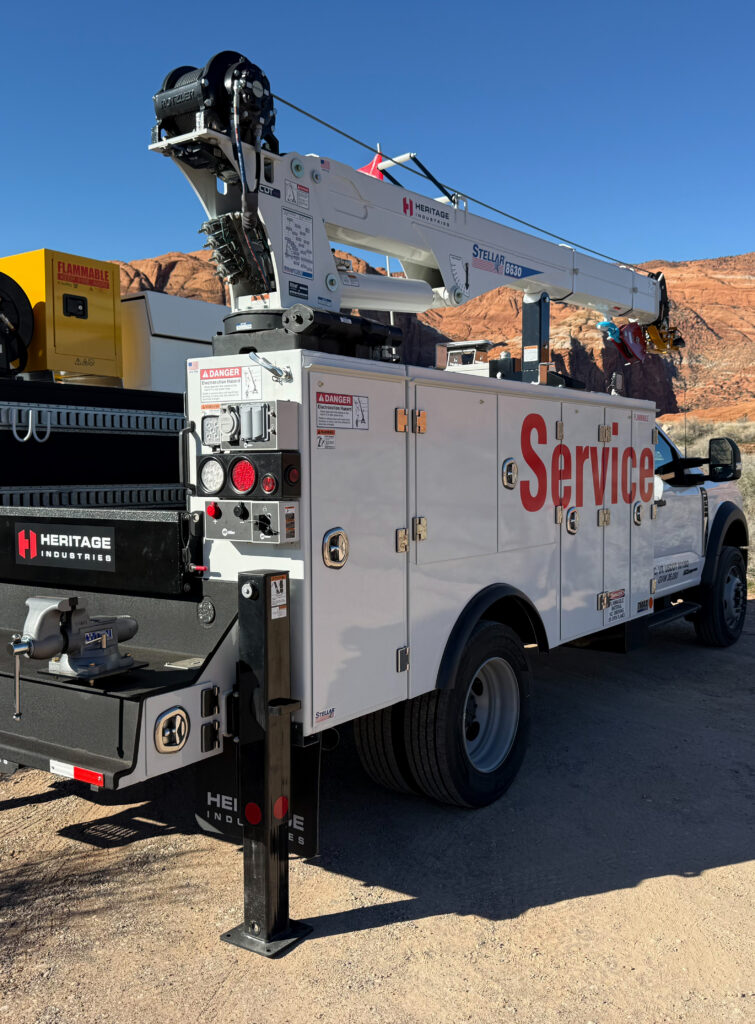
At the top end: the 12630
Twelve thousand pounds close in, still 2,665 pounds at 29 feet 3 inches, and a maximum vertical lift of 31 feet 9 inches. Its boost mode is rated at 77,800 ft-lb against a normal rating of 66,000. The winch runs 7/16 inch rope at 55 feet per minute, 6,000 pounds on a single part line and 12,000 on a double. It weighs 2,250 pounds before you add a body, which is the figure people forget.
The 86 series: 8630 and 8621
Same 8,600 pound capacity close in, same 19,000 GVWR minimum, differing in reach and weight: the 8630 goes to 29 feet 8 inches at 1,735 pounds, the 8621 to 21 feet at 1,580 pounds. If your work does not need the reach, the 8621 gives you 155 pounds back and a shorter stowed footprint. That is not much on its own, but payload on a mechanic truck is assembled out of small decisions.
The electric option: 3315
A 12-volt electric-hydraulic crane rated at 3,200 pounds with around 15 feet of reach, which runs with the truck’s engine off and needs no PTO. For lighter service work, for operators who want to work quietly, or for a truck where a PTO installation does not make sense, it is a genuinely different proposition rather than just a smaller crane. Talk to us about current specifications before sizing a build around it.
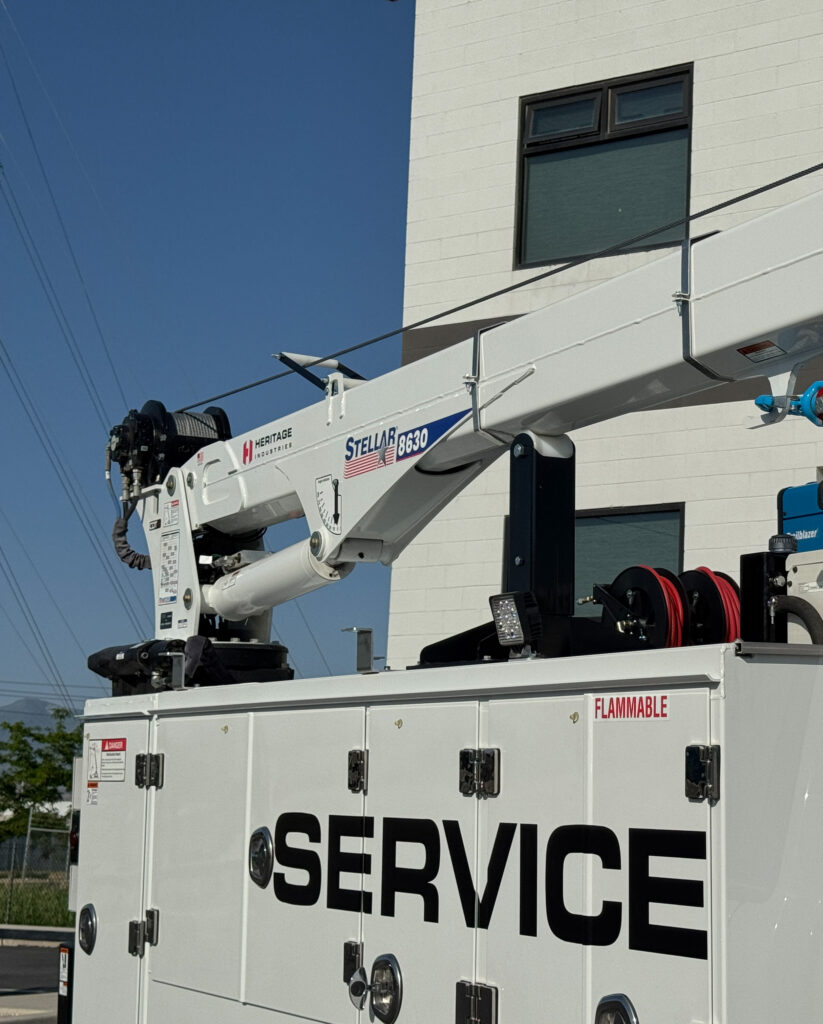
Choosing the Body
Stellar TMAX bodies use a Torq-Isolator torsion box understructure, which exists to solve one specific problem: a crane lifting load tries to twist the body, and that twist is what cracks compartments and jams doors on a cheaper build. The Torq-Isolator isolates those forces and transfers them into the chassis and stabilizers rather than the side packs.
| Body | Material | Chassis GVWR | Lengths | Net weight |
|---|---|---|---|---|
| TMAX 16K | Aluminum | 14,000 – 22,900 | 9′ or 11′ | 1,724 – 2,284 lbs |
| TMAX 1 | Steel or aluminum | 16,000 – 22,900 | 9′, 11′ or 13′ | Alum 2,718 – 3,330 lbs; steel 3,149 – 4,076 lbs |
| TMAX 2 | Steel or aluminum | 25,500 – 33,000 | 11′ or 14′ | Alum 3,459 – 3,960 lbs; steel 4,388 – 5,140 lbs |
All three share a 94 inch body width, a 50 inch floor width and 22 inch compartment depth. The TMAX 1 shell is 12-gauge two-sided A-40 galvanneal steel. Across the range you get stainless billet hinges on 5/16 inch stainless rod, three-point compression latches, a double-panel 1/8 inch aluminum tailgate, adjustable divider shelves rated at 250 pounds, and undercoating at a minimum of 6.5 mils.
The aluminum-against-steel decision here is the same one covered on our service body installation page, with one difference: on a crane truck the weight you save in the body is weight you can spend on the crane.
The Arithmetic Nobody Does Until It Is Too Late
Take a steel TMAX 2 at the heavy end of its range, 5,140 pounds, and put a 12630 on it at 2,250 pounds. That is 7,390 pounds of body and crane before you have counted the truck itself, the fuel, the crew, the tooling, the welder, the compressor or anything the crane is going to pick up. On a 33,000 GVWR chassis that is workable. On a lighter one it is not, and the point at which you discover this should not be after the chassis has been ordered.
We run this calculation as part of specifying a build. It is also why we ask awkward questions about what actually rides in the truck rather than what is supposed to.
PTO, Pump and Hydraulics
We do the chassis-side work: PTO, pump, plumbing, reservoir and the hydraulic system that drives the crane. The hydraulic cranes above call for 8 gpm at 3,000 psi, and getting that right is not optional — an underfed crane is slow and an overfed one is a maintenance problem. Doing the body, the crane and the hydraulics under one roof means there is nobody to point at when something does not work.
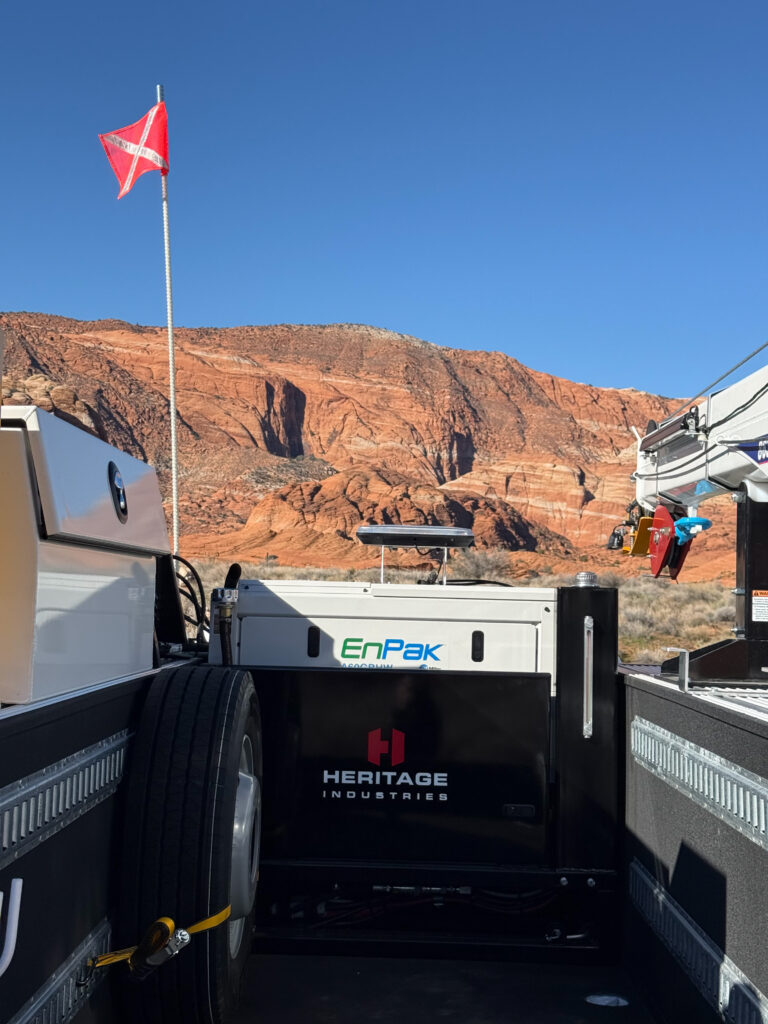
Onboard Power, Air and Welding
Most mechanic trucks need power, air and welding at the jobsite. We install Miller EnPak systems, including the A60GBHW: 325 amps of welding output at 100% duty cycle for stick, TIG and MIG, a rotary-screw compressor delivering 60 CFM at 100% duty cycle, a 16 gpm variable displacement hydraulic pump, 7,000 watts of continuous 120/240V generator power, and 150 amp charging with 300 amp crank assist. It runs on a 24.8 horsepower Kubota diesel, is specified for Class 5 and above, and Miller publishes a reduction in engine idle time of up to 75%.
We also build our own EnPak Quick Dock, which lets a crew un-dock and dock a power system in an hour or less on two stainless quick-release pins with pre-plumbed hydraulic, fuel, air and 12-volt connections. For a fleet moving a power system between chassis, that is a day’s work turned into an hour.
Inspection, Load Testing and Compliance
A crane is regulated equipment. ANSI B30.5 and OSHA 1910.180 set out inspection requirements, and meeting them is the operator’s responsibility, not the manufacturer’s.
Heritage performs crane inspections and load testing. We will inspect and test cranes we installed, cranes installed by somebody else, and brands we do not sell. If you are running cranes across a fleet and inspection is currently something that happens when somebody remembers, we can put it on a schedule.
Crane Service and Repair, Any Make
We service and repair hydraulic service cranes regardless of make or who installed them. Hydraulics, controls, structural repair and remount work. If a crane has failed in the field, submit a field service request and it is triaged by severity.
Build a Mechanic Truck
Tell us what the truck has to lift, how far out, and what else has to ride on it. We will come back with a crane, a body, a chassis class and a payload figure — in that order, because that is the order the decisions actually depend on each other.
4988 West 150 South, Salt Lake City, UT 84104
(385) 257-7950 · info@hibuilds.com
Monday to Friday, 7:00 am to 4:00 pm. Closed Saturday and Sunday.
Mechanic Truck FAQ
What chassis do I need for a 12,000 pound crane?
Stellar’s published minimum for the 12630 is 25,999 GVWR, which in practice means a TMAX 2 body and a heavier chassis than most buyers expect. If that is more truck than you want, the 8630 drops the requirement to 19,000 while keeping nearly the same reach.
Can I put a crane on a truck I already own?
It depends entirely on the chassis rating and the body. A crane cannot be added to a body that was not built for the loads — it cracks compartments — and the chassis has to carry the crane plus everything else. Bring us the truck and we will tell you honestly whether it is a candidate.
Do you inspect and load test cranes?
Yes, to ANSI B30.5 and OSHA 1910.180 requirements, on any make and regardless of who installed it. We can also put a fleet on a recurring inspection schedule.
Do you service cranes you did not sell?
Yes, any make. Hydraulics, controls, structural repair and remounts.
Electric or hydraulic?
Hydraulic if you need capacity or reach. Electric if you are lifting lighter loads, want to work with the engine off, or would rather avoid a PTO installation. The gap between them is large — 3,200 pounds against 8,600 or 12,000 — so it is usually an easy decision once the loads are known.
How much payload will I have left?
We calculate it before recommending anything. Body and crane together commonly run between 5,000 and 7,500 pounds depending on configuration, which is why the chassis conversation happens first.
What else can you fit?
Onboard power and air, protective coatings, lube systems and storage. The full range is on our truck upfitting page, and fleet programs are covered under fleet upfitting.